
Introduction: The Real Secret to Effective Networking
Many professionals believe that great networkers are smooth talkers. In reality, the most impactful communicators are world-class listeners. As was famously said of former US President Bill Clinton, “When he talks to you, it is like no one else is in the room.”
True connection isn’t achieved by dominating the conversation; it is forged by making the speaker feel deeply heard, understood, and valued. In corporate settings, practicing intentional listening is the fastest pathway to establishing rapport and building long-term commercial trust.
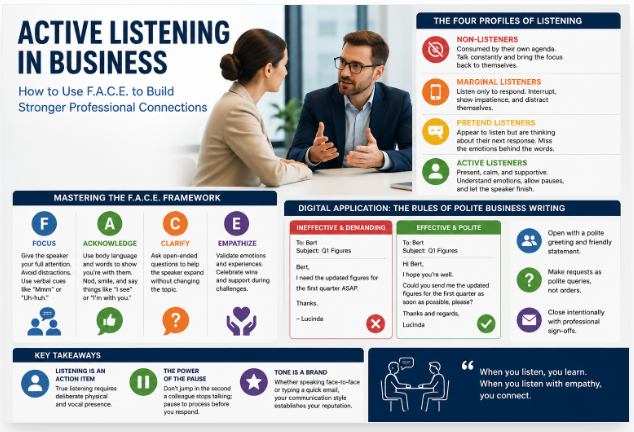
Main Content: The Four Profiles of Listening
Behavioral research indicates that corporate professionals generally fall into one of four distinct listening categories. Identifying these styles helps us consciously correct bad communication habits:
Non-Listeners
These individuals are entirely consumed by their own thoughts and agendas. They monopolize conversations, talk continuously, and look for any opportunity to bring the spotlight back to themselves.
Marginal Listeners
Marginal listeners listen only to find a springboard for their own ideas. They constantly interrupt, quickly become impatient, and signal their disinterest through negative body language—such as tapping fingers, looking around the room, or checking their mobile devices for emails.
Pretend Listeners
Pretend listeners give the surface appearance of paying attention, but internally, they are analyzing, judging, and formulating their next response. They hear the literal words being spoken, but they completely miss the emotional context and underlying feelings of the speaker.
Active Listeners
Active listeners are calm, present, and supportive. They don’t just process words; they identify the speaker’s emotional state (whether they are anxious, proud, or frustrated). They allow pauses, avoid interruptions, and wait for the speaker to completely finish before responding.
Mastering the F.A.C.E. Framework
To ensure your conversations match the standard of an active listener, utilize the acronym F.A.C.E. to anchor your interactions:
F ➔ Focus entirely on the speaker
A ➔ Acknowledge with verbal and physical cues
C ➔ Clarify with targeted, open questions
E ➔ Empathize to validate their experience
Focus
Give the speaker your absolute, undivided attention. Avoid looking at notifications or scanning the room. Use brief, encouraging vocal indicators like “Mmm” or “Uh-huh” to show you are locked into their narrative.
Acknowledge
Acknowledge the speaker’s perspective through active body language. Nod your head to show agreement, and match your facial expressions to the tone of their story—smile during a triumph, and remain serious during a challenge. Use phrases like “I see” or “I’m with you” to confirm alignment.
Clarify
Ask simple, open-ended questions that encourage the speaker to expand on their thoughts without changing the topic.
- “What happened next?”
- “Could you explain that part in a bit more detail?”
Empathize
Validate the speaker’s emotional reality or celebrate their wins explicitly. Use supportive phrases to show you grasp the scale of their experience:
- To celebrate success: “That is fantastic! Well done.”
- To support during trouble: “I’m sorry to hear that. I’m certain we can work this out together.”
Digital Application: The Rules of Polite Business Writing
Active listening principles aren’t limited to vocal interactions. Online relationships depend heavily on showing courtesy and respect through written text. Compare these two daily emails:
Ineffective & Demanding:
Bert, I need the updated figures for the first quarter ASAP. Thanks. – Lucinda
Effective & Polite:
Hi Bert, I hope you’re well. Could you send me the updated figures for the first quarter as soon as possible, please? Thanks and regards, Lucinda
To maintain strong rapport over digital channels, apply these core conventions:
- Always open with a polite greeting and friendly statement (e.g., “I hope things are going well with you”).
- Phrase requests as polite queries, never orders (e.g., use “Could you please…” instead of “I need…”).
- Close intentionally using professional phrases like “Kind regards,” “Best wishes,” or “Thanks and regards.”
Key Takeaways
- Listening is an Action Item: True listening requires deliberate physical and vocal presence.
- The Power of the Pause: Don’t jump in the second a colleague stops talking; pause briefly to process their perspective before formulating your answer.
- Tone is a Brand: Whether speaking face-to-face or typing a quick email, your communication style establishes your personal reputation.