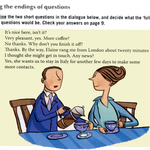
Short questions in English help us communicate naturally, politely, and efficiently. In everyday conversations, we do not always use complete grammatical questions. Instead, we often use short expressions to ask for information, offer something, make suggestions, or keep a conversation going.
For example, instead of asking, “Would you like another cup of tea?”, we can simply say, “More tea?” Similarly, instead of asking someone whether they have received any messages, we can ask, “Any messages?”
These expressions are especially common in spoken English. Learning them can help English learners understand native speakers, participate in everyday conversations, and sound more natural when speaking.
In this lesson, you will learn how to use short questions in English, including shortened questions, expressions with about, and questions that end with prepositions. You will also find examples, practice exercises, and an answer key.
1. What Are Short Questions in English?
Short questions are brief questions that communicate a complete idea without necessarily including every word of a longer grammatical question.
Speakers often use them because the context makes the meaning clear. They are common when talking to friends, family members, colleagues, and other people in everyday situations.
Consider these examples:
| Full question | Short question |
|---|---|
| Would you like some more coffee? | More coffee? |
| Have there been any messages? | Any messages? |
| Have you had any luck finding a job? | Any luck? |
| Is there any chance you could help me? | Any chance you could help me? |
Short questions are particularly useful when offering food or drinks, checking for news, asking about progress, or continuing a conversation.
Why do we use short questions?
We use short questions to:
- Make everyday conversations more natural.
- Avoid repeating information that is already understood.
- Offer food, drinks, or assistance.
- Ask whether there is any news or progress.
- Find out what another person thinks or wants.
- Make suggestions.
- Ask for information about films, television programmes, books, and other activities.
The meaning depends on the situation, so it is important to consider the conversation as a whole.
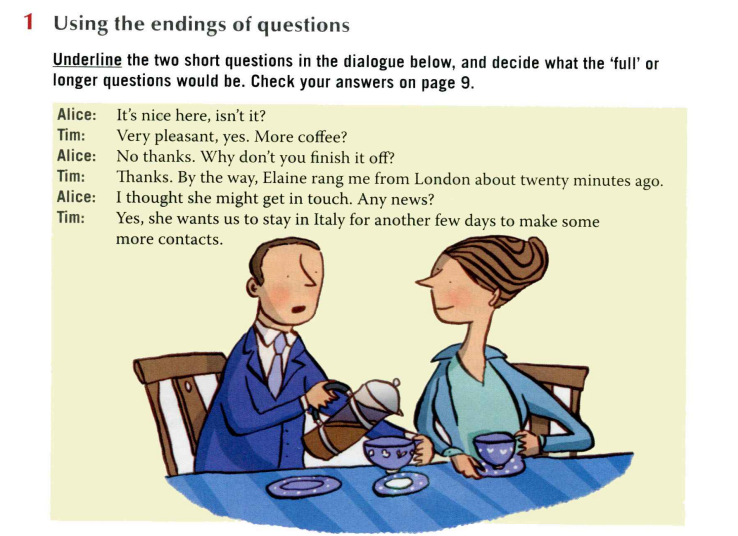
2. Using the Endings of Questions
One common way to form short questions in English is to use the final part of a longer question. This is especially common when the topic is already clear.
2.1. Offering more food or drinks
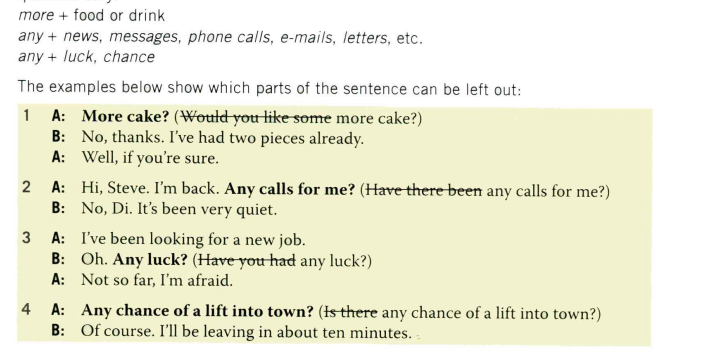
When offering someone more food or a drink, we can use more followed by the name of the item.
Examples:
- More tea?
- More water?
- More cake?
- More orange juice?
- More sugar?
These expressions are shorter alternatives to questions such as “Would you like some more tea?” or “Would you like some more cake?”
Example conversation
A: Would you like some more water?
B: More water?
A: Yes, there’s plenty left.
B: Yes, please. Thank you.
In everyday conversation, the speaker can simply say “More water?” if the situation makes the meaning clear.
2.2. Asking about news and messages
We often use any followed by a noun when asking whether something has happened or whether there is something to report.
Common expressions include:
- Any news?
- Any messages?
- Any calls?
- Any emails?
- Any letters?
For example:
A: I’ve just returned from my holiday. Any messages?
B: Yes, there are two emails you need to read.
The short question “Any messages?” is a natural alternative to “Have there been any messages?”
2.3. Asking about progress or success
We can also use any luck? to ask whether someone has made progress or achieved something they wanted.
For example:
A: I’ve been looking for a new apartment.
B: Any luck?
A: Not yet, but I’ve arranged two viewings.
Here, “Any luck?” means “Have you had any luck?”
2.4. Asking whether something is possible
The expression any chance of…? is useful when asking whether something might be possible.
Examples:
- Any chance of a lift to the station?
- Any chance of getting a later appointment?
- Any chance of borrowing your notes?
For example:
A: Any chance of a lift to the station?
B: Of course. I’m leaving in fifteen minutes.
The full question might be “Is there any chance of getting a lift to the station?” The shortened expression is appropriate when the situation is clear.
2.5. Intonation in short questions
Intonation is important when using short questions. When offering something or checking information, speakers often use rising intonation, particularly when they expect a response.
Compare:
- More coffee? ↗
- Any news? ↗
- Any chance of a lift? ↗
The voice rises towards the end, making the expression sound like a question.
However, intonation can vary according to context, attitude, and the speaker’s intention. Listen to natural conversations and practise saying these expressions aloud.
3. Using “What About You?” and “How About…?”
The expressions what about and how about are common in spoken English. They can help us ask for another person’s opinion, discover their preferences, and make suggestions.
Although the expressions are related, their meanings depend on how they are used.
3.1. “What about you?”
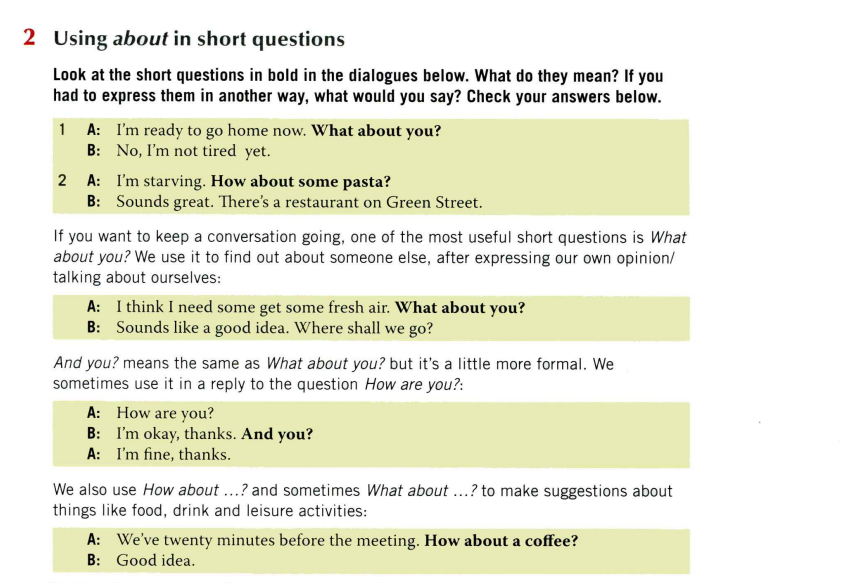
We often use What about you? after talking about ourselves to ask another person the same question or invite them to share their opinion.
Example:
A: I usually study in the evening. What about you?
B: I prefer studying early in the morning.
In this conversation, the first speaker shares a personal habit and then asks about the other person’s routine.
Other examples:
- I love travelling. What about you?
- I’m ready to leave. What about you?
- I think this exercise is difficult. What about you?
- I prefer working from home. What about you?
This expression is useful because it helps conversations continue instead of ending after one person has spoken.
3.2. “And you?”
And you? has a similar meaning to What about you? It is frequently used in short exchanges and can sound slightly more formal or neutral, depending on the situation.
For example:
A: How are you?
B: I’m fine, thank you. And you?
A: I’m doing well, thanks.
We can also use it when asking about someone’s preferences or situation.
A: I work in the afternoon.
B: And you? Do you work in the morning?
In the second example, the speaker uses And you? to return the question to the other person.
3.3. “How about…?” for suggestions
We commonly use How about…? to suggest an activity or propose an idea.
Examples:
- How about a cup of coffee?
- How about going for a walk?
- How about watching a film?
- How about meeting after work?
- How about trying a different restaurant?
Notice that How about can be followed by a noun phrase or an -ing form.
Structure 1: How about + noun phrase?
How about a sandwich?
How about a short break?
How about a game of tennis?
Structure 2: How about + verb-ing?
How about taking the bus?
How about studying together?
How about visiting the museum?
These structures are useful when making friendly suggestions.
3.4. “What about…?” for suggestions and other situations
What about…? can also introduce a suggestion, but it may additionally draw attention to a problem, an alternative, or something that has not yet been considered.
For example:
A: We could have lunch at home.
B: What about eating at the new café?
Here, the second speaker proposes an alternative.
Compare the following examples:
- What about you? — Asks about another person’s situation, feelings, or opinion.
- How about some tea? — Offers a drink.
- How about going for a walk? — Suggests an activity.
- What about the cost? — Raises a point that needs consideration.
The surrounding conversation helps determine the intended meaning.
3.5. How to keep a conversation going
One useful communication technique is to respond to someone’s statement and then invite them to contribute.
Example:
A: I’m thinking about learning Spanish.
B: That’s interesting. What about taking an evening course?
A: Good idea. What about you? Are you learning any new skills?
B: Yes, I’m learning how to use a new computer programme.
This type of exchange combines reactions, suggestions, and follow-up questions. It helps both speakers participate actively.
For more expressions used in everyday communication, explore Common Phrases on InsightWorks Publishing.
4. Short Questions with Prepositions
In English, prepositions often appear at the end of questions. This is especially common in everyday spoken English.
Examples include What’s on?, What’s it about?, When’s it on?, Who’s in it?, and Who’s it by?
These questions are useful when talking about entertainment, books, films, television programmes, and other cultural activities.
4.1. “What’s on?”
We use What’s on? to ask what is showing or happening, particularly at a cinema, theatre, or on television.
Examples:
- What’s on at the cinema tonight?
- What’s on TV this evening?
- What’s on at the theatre this weekend?
Conversation:
A: Shall we go to the cinema tonight?
B: Good idea. What’s on?
A: There’s a comedy and a science-fiction film.
The question helps the speaker find out which programmes, films, or events are available.
4.2. “What’s it about?”
We use What’s it about? to ask about the subject or main idea of a film, book, television programme, or similar work.
Examples:
- What’s the film about?
- What’s the book about?
- What’s that documentary about?
Conversation:
A: I’m reading a novel about a young journalist.
B: Really? What’s it about?
A: It follows her investigation into a local mystery.
The short question allows the listener to ask for more information without repeating the full noun phrase.
4.3. “When’s it on?” and “What time’s it on?”
These expressions ask when a programme, film, or event starts.
Examples:
- When’s the match on?
- What time’s the programme on?
- When’s the film on?
Conversation:
A: There’s an interesting documentary tonight.
B: What time’s it on?
A: At nine o’clock.
These expressions are useful when arranging to watch something or planning an outing.
4.4. “Who’s in it?”
We use Who’s in it? to ask which actors or performers appear in a film, series, or television programme.
Example:
A: Have you seen the new historical film?
B: Not yet. Who’s in it?
A: It features several well-known actors.
The pronoun it refers to the film or programme already mentioned.
4.5. “Who’s it by?”
We use Who’s it by? to ask who created a particular work. Depending on the context, we may be asking about the writer, director, composer, or performing artist.
Examples:
- Who’s the book by?
- Who’s the film by?
- Who’s that song by?
Conversation:
A: I really like this novel.
B: Who’s it by?
A: It’s by a contemporary British writer.
The context tells us which type of creator the speaker wants to know about.
4.6. “What’s up?”
The expression What’s up? has several possible meanings. In everyday conversation, it often means What’s wrong? or What’s the matter? when someone appears worried, upset, or different from usual.
Example:
A: You seem worried. What’s up?
B: I’ve lost my keys.
It can also be used informally as a greeting, depending on the situation.
For example:
A: Hey! What’s up?
B: Not much. How are you?
The meaning depends on the speaker’s tone, relationship with the listener, and conversational context.
For more useful expressions and ways to communicate intentions, see Functional Language.
5. Practical Tips for Using Short Questions Naturally
Understanding the grammar is only part of learning spoken English. You also need to know when and how to use these expressions.
Tip 1: Pay attention to context
Short questions work best when the listener already knows what you are talking about.
For example, after discussing a job search, asking “Any luck?” is clear. Without that context, the listener might not know what kind of success you mean.
Tip 2: Use an appropriate tone
Short questions can sound friendly, interested, polite, or impatient depending on intonation and context.
When offering food or asking about someone else’s situation, use a natural and welcoming tone.
Tip 3: Practise complete and shortened forms
Learn the full question alongside the short version.
- Would you like some more tea? → More tea?
- Have there been any messages? → Any messages?
- Have you had any luck? → Any luck?
- Is there any chance of a lift? → Any chance of a lift?
This helps you understand both forms when listening and speaking.
Tip 4: Listen for weak forms
In natural speech, some words are pronounced with less emphasis than others. In expressions such as How about…?, the word about is often unstressed.
Practise listening to short dialogues and notice which words receive the strongest emphasis.
Tip 5: Practise with real situations
Use these expressions while arranging meetings, talking about hobbies, asking about films, offering refreshments, and catching up with friends.
Regular practice helps you choose the appropriate expression without translating every sentence from your first language.
6. Practice Exercises: Short Questions in English
Complete the following exercises to check your understanding.
Exercise 1: Make the questions shorter
Rewrite each question as a natural short question where appropriate.
- Would you like some more coffee?
- Have there been any messages?
- Do you want some more orange juice?
- Has there been any news?
- Have we had any phone calls?
- Would you like some more sugar?
Exercise 2: Complete the conversation
Replace the longer questions with shorter versions where possible.
Situation: Friends having dinner
A: That was delicious! Thank you.
B: You’re welcome. Would you like some more pasta?
A: No, thank you. I’m full.
B: Would you like some coffee?
A: Yes, please.
B: Is there any chance you would like something cold to drink as well?
A: No, coffee is fine, thanks.
Exercise 3: Complete the questions
Choose an appropriate expression to complete each conversation. Use What about you?, And you?, How about…?, or What about…?
- A: I think I’ve eaten enough. __________
B: I still have room for dessert! - A: How are you?
B: I’m fine, thanks. __________
A: I’m very well, thank you. - A: __________ playing tennis tomorrow?
B: That sounds fun! - A: I haven’t bought my clothes for the wedding yet. __________?
B: No, I haven’t either. - A: __________ a cup of coffee?
B: It’s a little late for me, I’m afraid. - A: We haven’t decided what to do on Saturday.
B: __________ seeing that new film?
Exercise 4: Match the short questions to their meanings
Match questions 1–5 with meanings A–E.
- What’s on?
- What’s it about?
- What time’s it on?
- Who’s in it?
- Who’s it by?
A. Who are the actors or performers?
B. What is the main subject?
C. What is showing at the moment?
D. Who created the work?
E. When does it start?
Exercise 5: Complete the film conversation
Use suitable short questions from Exercise 4.
A: What shall we do tonight?
B: How about seeing a film?
A: Good idea. There’s a new thriller at the cinema.
B: Great! __________?
A: It’s directed by a famous filmmaker.
B: Interesting. __________?
A: It’s about a detective investigating a mysterious crime.
B: __________?
A: It starts at 8:30 p.m.
Exercise 6: Complete the messages
Choose suitable expressions from this box.
Any luck? — What’s on? — What about you? — What’s up? — How about…? — Any news?
Message 1
Hi Sam,
I haven’t seen you at college recently. __________ Are you okay? Last time we spoke, you were looking for a part-time job. __________
Anyway, let’s meet for a drink one evening. __________ going to the cinema afterwards?
Message 2
Hi Alex,
I’m fine, thanks, although I’ve been busy with family matters. I also found a part-time job at a local restaurant.
__________? You were looking for a part-time job too, weren’t you?
Let’s meet on Monday evening. __________ meeting at our usual café at seven?
Catching a film sounds good. __________ at the cinema this week?
Exercise 7: Writing practice
Write short messages for the following situations.
- Write a message to your flatmate asking what you need to buy for the house.
- Write a message to a friend suggesting that you have lunch together.
- Write a message to a colleague asking for news from work while you have been away.
Use short questions where appropriate.
Exercise 8: Speaking practice
Work with a partner. Imagine that two old friends are meeting after several years apart.
Write a dialogue that includes at least four of the following expressions:
- What about you?
- Any news about…?
- Any chance of…?
- How about…?
- When’s it on?
- What’s up?
Practise the dialogue aloud. Pay attention to word stress, intonation, and natural responses.
7. Answer Key
Exercise 1
Possible answers:
- More coffee?
- Any messages?
- More orange juice?
- Any news?
- Any calls?
- More sugar?
Exercise 2
Possible shortened forms:
- More pasta?
- Any coffee? (Possible in suitable contexts, although “Coffee?” is also natural.)
- Anything cold to drink? (A natural shortened alternative, depending on context.)
Some questions may remain in their full forms if shortening them would sound unnatural or unclear.
Exercise 3
- What about you?
- And you?
- How about
- What about you?
- How about
- How about
Other answers may be possible depending on the intended meaning and sentence structure.
Exercise 4
- C — What is showing at the moment?
- B — What is the main subject?
- E — When does it start?
- A — Who are the actors or performers?
- D — Who created the work?
Exercise 5
Possible answers:
- What’s it by?
- What’s it about?
- What time’s it on?
The first answer asks about the film’s creator; the second asks about its subject; the third asks when it starts.
Exercise 6
Possible answers:
Message 1
- What’s up?
- Any luck?
- How about
Message 2
- What about you?
- How about
- What’s on?
Other expressions may fit if the surrounding message is adjusted to match their meaning.
Exercises 7 and 8
Answers will vary. Check that the messages and dialogues are clear, use the expressions appropriately, and sound natural in context.
8. Frequently Asked Questions
What are short questions in English?
Short questions are brief expressions used to ask for information, make suggestions, offer something, or continue a conversation. Examples include “Any news?”, “More coffee?”, and “What about you?”
Why do English speakers use short questions?
English speakers often use short questions because the context makes the meaning clear. They can make conversations more natural and reduce unnecessary repetition.
What is the difference between “What about you?” and “How about you?”
Both expressions can ask about another person’s situation or opinion. What about you? is especially common after sharing information about yourself. How about you? can serve a similar purpose, while How about…? is also frequently used to make suggestions.
What does “Any luck?” mean?
“Any luck?” is an informal way to ask whether someone has made progress or achieved something they were trying to do.
What does “What’s up?” mean?
“What’s up?” can be an informal greeting or a question about a problem. When someone looks worried, it often means “What’s wrong?” or “What’s the matter?”
Is it correct to end a question with a preposition?
Yes. In everyday English, questions such as “Who are you talking to?”, “What’s it about?”, and “Who’s it by?” are natural and grammatically acceptable.
How can I improve my spoken English?
Practise short dialogues, listen to natural conversations, pay attention to intonation, and use expressions in realistic situations. Learning both full and shortened question forms will also improve your listening comprehension and speaking fluency.
Conclusion
Short questions are an important part of natural spoken English. They help speakers offer food and drinks, ask about news, check progress, make suggestions, express interest, and find information about entertainment.
By learning expressions such as Any news?, What about you?, How about…?, What’s on?, and What’s up?, you can make your conversations more natural and confident.
The key is to understand the meaning of each expression, recognize the context in which it is used, and practise using it with appropriate stress and intonation.
Continue learning practical English expressions with Common Phrases and Functional Language on InsightWorks Publishing.